Personal banking at CommBank
Accounts for salary and spending, cards that adapt to your habits, savings that grow on autopilot and a clear path to your first home loan. This guide compares every option.
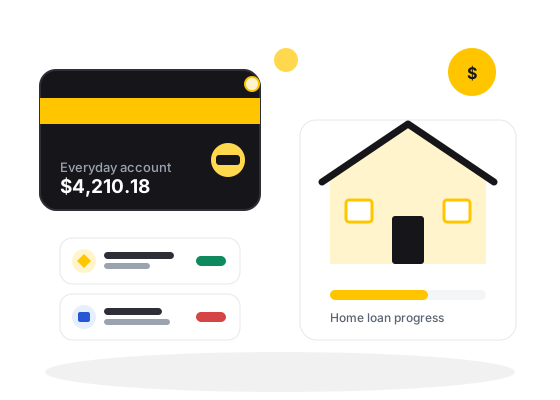
Choose the right everyday account
The account you receive your salary into shapes everything else. Match it to your monthly behaviour, not to marketing labels.
| Account type | Best for | Key trait | Typical fee |
|---|---|---|---|
| Everyday transaction | Salary, bills and daily spending | No-fee standard option, instant NetBank access | $0 monthly |
| Youth / student | Under 18s and full-time students | No monthly fees, parental visibility option | $0 monthly |
| Rewards everyday | High card usage | Points or cashback on eligible purchases | Conditional |
| Joint account | Couples and shared household costs | Two full-access owners, shared statements | $0 monthly |
| High-interest savings | Parking money you do not spend | Bonus rate when monthly deposit conditions are met | $0 monthly |
How to decide: open NetBank and look at your last three months of transactions. More than 40 card payments a month points to a rewards account; a growing idle balance points to high-interest savings.
Debit or credit — know the difference
A debit card spends the money you already have. A credit card spends the bank's money up to a limit, and you repay it later. Both live in NetBank with the same controls.
- Debit: zero interest risk, instant link to your everyday account, ideal as the default card.
- Credit: purchase protection and rewards, but interest applies unless the balance is cleared in full each cycle.
- Both: one-tap freeze, per-category limits and instant notifications for every charge.
Savings goals with momentum
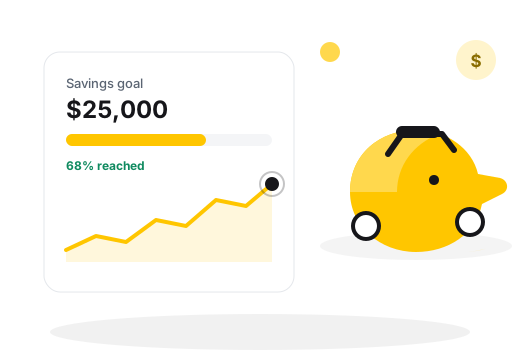
Willpower is a bad savings strategy. CommBank savings tools automate the process so money moves before you can change your mind.
- Round-ups: every card purchase rounds to the next dollar and the spare change moves to your goal.
- Scheduled top-ups: payday transfers that happen automatically.
- Milestone alerts: notifications at 25%, 50%, 75% and completion keep motivation high.
The path from deposit to keys
A home loan is a marathon, not a sprint. Understanding the sequence removes most of the stress.
-
Build and protect the deposit
Use a dedicated high-interest savings goal. Lenders like to see genuine savings history, not a sudden lump sum.
-
Check serviceability
Compare your stable income against existing debts. Banks apply a buffer above the current rate to test affordability.
-
Choose fixed, variable or split
Fixed gives certainty, variable gives flexibility, split gives both in proportions you control.
-
Track progress in NetBank
Once approved, repayments, balance and offset behaviour all appear in the same dashboard as your everyday accounts.
Personal banking questions
Which everyday account should I choose?
Choose based on your monthly behaviour: if you deposit regularly and want no monthly fee, pick the standard everyday account; if you travel or use your card heavily, compare the rewards option. See the account table above.
What is the difference between debit and credit cards?
A debit card spends money you already have. A credit card borrows up to a limit and bills you later, with interest if the balance is not repaid in full. Debit is simpler; credit adds protection and rewards when managed responsibly.
How do savings goals work?
Create a named goal, set a target and choose automatic top-ups such as round-ups or scheduled transfers. Progress is tracked in NetBank with milestone notifications.
What do I need to apply for a home loan?
Typically proof of identity, income statements, a list of existing debts and a deposit. The lender then assesses serviceability — whether repayments fit your income with a safety buffer.
Banking for your business?
If you run a company or side project, the business guide covers transaction accounts, terminals and lending.